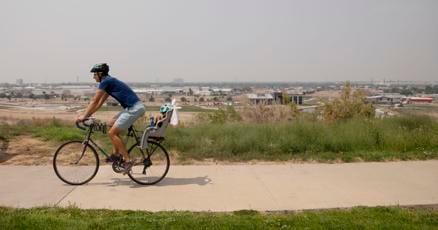
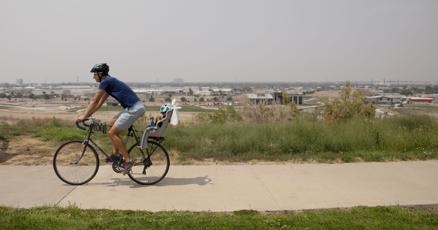
Don’t hold your breath — this hazy Grand Junction sky could last a while.
Current Air Quality
According to county and state air quality monitoring systems, Grand Junction’s skies currently carry minimal pollutants and risk to residents. But, that doesn’t guarantee the clear skies many locals hope to see during the summer.
Why is it Hazy?
According to Dennis Phillips, meteorologist for the National Weather Service’s Grand Junction Forecast Office, the shift in visibility is almost as inevitable as the shift in seasons.
“This time of year, there’s always wildfire smoke that gets stuck in the circulation,” Phillips said. “The main culprit is we’ve had high pressure sitting over us, (which) absorbs the smoke from all the fires that have been going — everywhere from California to Washington to probably even Canada.”
Wildfire Impact
The Sentinel reported last Friday that the Upper Colorado River Interagency Fire and Aviation Management Unit — which oversees the region between the Continental Divide and the eastern Utah border — has seen 71 fires since the start of the year. Within the same timeframe last year, the agency had seen 28 fires.
While this notable uptick in fires on the Western Slope (which were majority human-caused) has impacted the local visibility, Phillips said wildfires from all across the nation can play an even larger role.
“It may not be our neck of the woods all the time. I saw a post (on X) earlier where it’s really bad up in the Northwest, and it’s a lot worse than here,” Phillips said. “You wouldn’t even see the Monument if it was as bad, (but) luckily, we don’t have that right now.”
Climate Change and Future Predictions
According to Mesa County Public Health’s environmental health specialist, Merry Ellen Boom, the frequency of wildfires and resulting pollution will likely continue to increase as a result of climate change. She said this trend will also raise the importance of individuals monitoring their local air quality and planning their day accordingly.
“You brush your teeth because you want to keep your teeth healthy, so the same thing would be to look at the air quality index and determine what you’re going to do for that day,” Boom said. “If there’s haze in the air from the wildfires, that’s going to affect you.”
Health Implications
Boom added that the risks are higher for small children, the immunocompromised and those with respiratory issues such as COPD and asthma because they do not have the capacity (or they lost the ability) to efficiently process particulates in the air.
Precautions to Take
Although there are currently no air quality advisories, Boom said monitoring air quality is important in ensuring residents are aware and able to take precautions for their respiratory health. According to her, the number one step anyone can take is to stay indoors during poor air quality.
“If you had to go out, let’s say to pick up your meds at Walgreens, pick a time of the day in the very early morning where the weather hasn’t mixed up (the particulates) yet, or after dark when the winds settle down and things aren’t being kicked up so much,” Boom said.
She added that swamp coolers should be avoided, as they typically cannot filter pollutants and bring them indoors. Additionally, she said the county is not in a residential burn season, so locals should ensure they avoid starting any fires and releasing more particulates into the air.
When Will It Clear?
Given that many of the contributing wildfires are outside of Colorado, it’s difficult to predict when the resulting haze could subside; however, Phillips said that the seasonal patterns in pressure that lessen wildfires and haze typically won’t arrive until the fall.
“This high pressure is (in) a clockwise circulation that’s shifted a little bit, but it’s still sitting over the Rocky Mountain region,” Phillips said. “Sometimes you can have little pattern changes that will sweep everything out for a day or two, but they’ll come right back.”
“You won’t get rid of the smoke until October or November when we go through a season change and those fires finally get put out by either snow or cooler weather.”
Hot Summer Days
Similar to the hazy skies, Phillips said the recent bout of hot summer days is unlikely to end soon based on historical trends, although no prediction is 100%.
He added that it’s impossible to say whether the area will see any record-setting or advisory-level heat, but the peak of the season is just now approaching.
“Much of July and into August we can still get these triple-digit readings; the latest we’ve had triple digits may even be into September,” Phillips said.
For more information, visit the full article here.
No responses yet