Introduction to Free Consultations
The Sorenson Legacy Foundation Center for Clinical Excellence is now providing 1-hour, single-session consultations free of charge.
The services are available to adults ages 18 and above at the Sorenson Center, a community-facing clinical services facility located on USU’s Logan campus. The consultations are supported, in part, through a grant provided by the Bear River Health Department to the Sorenson Center, which is part of the Emma Eccles Jones College of Education and Human Services.
Who Can Access These Services?
The single-session consultations are accessible to adults in both Utah and Idaho. According to research, approximately 20% of Utah adults experience poor mental health, and as many as half of those individuals do not currently receive mental health treatment or counseling. Utah also has a shortage of mental health providers in every county in the state.
Community members in Cache, Box Elder, and Rich counties are encouraged to participate in the complimentary service in-person. However, the Sorenson Center is equipped to deliver sessions to anyone in Utah and Idaho via telehealth.
Understanding the Consultation Model
The consultations are based on a model created by Jessica Schleider, Ph.D., psychologist and director of the Lab for Scalable Mental Health at Northwestern University. Schleider’s model assumes that change can, and is expected to, occur in the moment. She emphasizes that clients have the inner capacity to change their thoughts, emotions, and behaviors, which inherently empowers the individual.
What to Expect During a Session
Gretchen Peacock, director of the Sorenson Center and associate dean of the Emma Eccles Jones College, explains the practicality and inherent value of a single-session consultation.
“When people are in the moment with a particular problem or decision, they tend to get stuck,” she said. “They feel overwhelmed. But most people have it within themselves to come up with some ideas. They just need some assistance with their problem solving. That’s the focus of these single-session consultations. We are working to empower the individual to come up with ideas to solve their own problems.”
The sessions are provided by licensed clinicians at the Sorenson Center as well as graduate students in training. Marissa Donahue, a 5th year doctoral graduate student in the Combined Clinical/Counseling specialization in the ACT (acceptance and commitment therapy) Research Group at Utah State, is one of the single-session consultation providers.
“There’s evidence to show that brief interventions can result in meaningful behavior change,” Donahue said. “Even taking the first step of coming in and speaking about a particular problem — and feeling validated when someone else hears it — can increase awareness, which has a lot of value.”
How Does a Session Work?
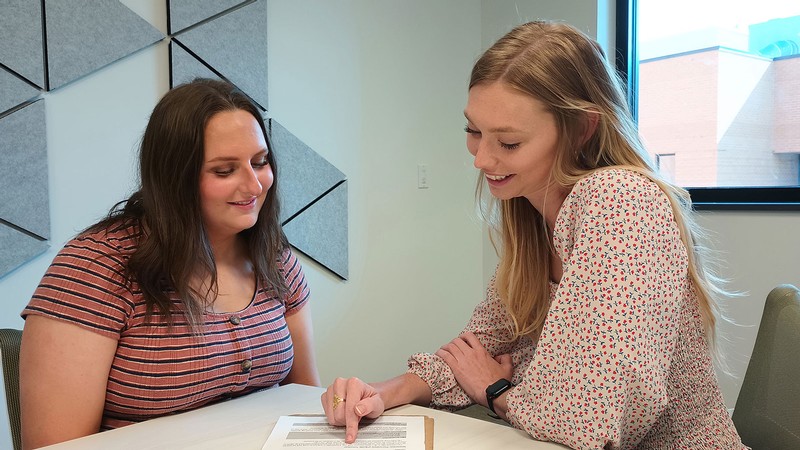
Donahue described what a session will look like.
“Someone might come in and say, ‘I’m really stressed,’” she said. “We’ll focus on identifying a more specific problem by identifying contexts and specific goals to ultimately create an action plan together that is solutions focused. There is a commitment that the person will then go and practice the plan.”
She added: “It’s common to describe our emotions as happy, stressed, sad, mad. When you meet with someone in a session, you get a chance to more accurately describe and identify what’s going on. I think that in itself is an intervention of sorts.”
Are These Consultations for Everyone?
Donahue is optimistic about the results of a single-session consultation.
“My hope is that people will take their plans and begin to apply this skillset of identifying solutions to other contexts as needed,” she said. “If they can find the solution helpful for anxiety around academic performance, can they then apply it to anxiety that shows up in another situation? I believe people can have behavior change without requiring 12 weeks of services.”
Peacock acknowledges that the sessions aren’t designed to help everyone with every condition.
“People need to understand that this isn’t therapy,” she said. “If they are dealing with trauma or thoughts of suicide or severe anxiety, there are other resources available. We understand that an hour consultation is not going to solve everyone’s problems. But it can be a positive step forward for a lot of people.”
The Purpose of the Grant
Ultimately, the purpose of the Bear River Health Department’s grant to the Sorenson Center is two-fold.
“We’re trying to get mental health services out to more people who need them,” Peacock said. “We know there is a need for services, and it can be difficult to get into providers, so we want to reach more people. That’s our main goal. This is also a good way to give people an introduction to therapy.”
Additional Services Offered
In addition to the single-session consultations, the Sorenson Center serves individuals throughout Utah with an extensive array of clinical services, provided both in-person and via telehealth.
The services are provided by licensed mental health therapists and graduate students in training who are closely supervised by experienced faculty. While the single-session consultations are provided at no cost, other services are provided on a modest sliding scale fee or insurance may be billed.
The center also provides single-day and multi-week group meetings and workshops that are designed to provide support and education for the community. To learn more about its many services, visit the Sorenson Center’s website. To sign up for a free single-session consultation, visit this webpage.
No responses yet