Average life expectancy among First Nations people in British Columbia has dropped by more than six years between 2017 and 2021, according to a report released Wednesday by the First Nations Health Authority and the office of the provincial health officer.
Life expectancy data is ‘gut wrenching,’ says deputy provincial health officer for Indigenous health

The report indicates that Indigenous life expectancy in B.C. fell from 73.3 years in 2017 to 67.2 years in 2021. Life expectancy for First Nations males declined by 6.8 years, while females saw a decrease of 5.2 years, resulting in an overall decline of 6.1 years.
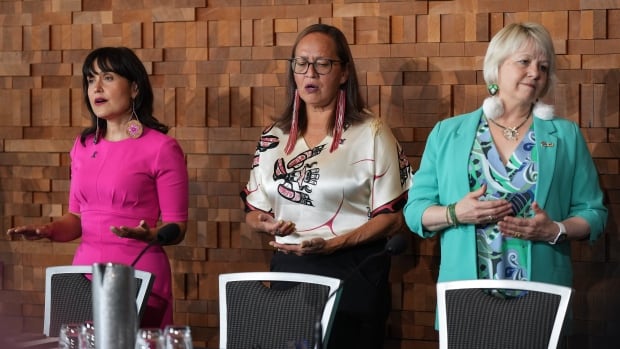
Dr. Daniele Behn Smith, deputy provincial health officer for Indigenous health, expressed that this life expectancy data is “gut wrenching.”
Dr. Nel Wieman, First Nations Health Authority’s chief medical health officer, attributed the decline primarily to the COVID-19 pandemic and the province’s opioid overdose crisis.
Wieman highlighted that Indigenous populations faced greater challenges due to these dual public health emergencies, revealing persistent gaps in B.C.’s health-care system.
‘We’re not where we need to be yet’
Provincial Health Officer Dr. Bonnie Henry remarked that the report indicates “modest improvement,” but emphasized that “we’re not where we need to be yet.”
She noted that the data illustrates the historical context of health and wellness for First Nations people and the necessary steps moving forward.

Wieman stated that the data will empower First Nations chiefs and health-care leaders to advocate for necessary changes.
“These are people who are currently trying to live their lives despite challenges, and the data also points to people who have lost their lives … who are missing from our dinner tables and our ceremonies — generations of people have been affected,” Wieman remarked.
While the report highlights improvements in high school graduation rates among First Nations students and a decrease in Indigenous infant mortality, it also reveals that only 0.39 percent of doctors in B.C. self-identify as First Nations.
Despite rising graduation rates among First Nations youth, Wieman emphasized the need for the education system to foster an environment that encourages young Indigenous people to pursue careers in medicine.
Behn Smith added that there has been no recent improvement in the percentage of physicians in B.C. who self-identify as First Nations.
“Clearly we can’t do it on our own,” she concluded.
Working together: two-eyed seeing
Wednesday’s report updates monitoring of First Nations health and wellness indicators conducted from 2020 to 2030, following a 2021 report.
Henry described the report as a “two-eyed seeing,” integrating Western medicine and Indigenous knowledge.
“We take the best of Western world and the best of Indigenous knowledge, and ways of knowing and being, and we hold them up equally,” Henry stated. “And that helps us understand a broader perspective of what makes people vibrant, healthy communities and individuals — it’s good for all of us.”
ABOUT THE AUTHOR

Bridget Stringer-Holden is a 2024 Joan Donaldson Scholar. She recently graduated from UBC’s Master of Journalism program and is passionate about science and climate reporting. She has written for The Globe and Mail, Vancouver Magazine, BCBusiness, The Vancouver Sun, The Georgia Straight and a variety of student publications. You can reach her at bridget.stringer-holden@cbc.ca.
With files from The Canadian Press
Comments are closed