
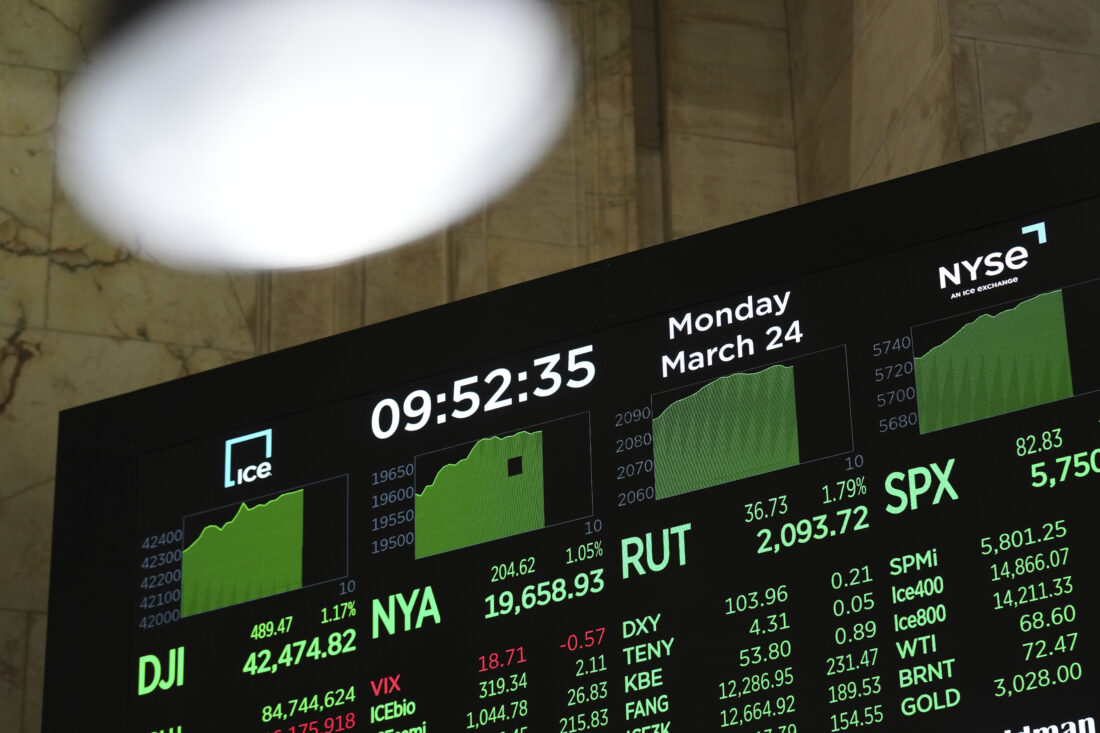
Financial information is displayed on the floor at the New York Stock Exchange in New York on March 24, 2025. (AP Photo/Seth Wenig)
NEW YORK (AP) — Wall Street faces mixed signals amid President Donald Trump’s latest tariff announcements affecting the auto industry. As tariffs elevate uncertainty, some auto stocks decline while U.S. electric vehicle manufacturers see improvements.
In late trading, the S&P 500 recorded a drop of 0.2%, fluctuating throughout the day. The Dow Jones Industrial Average fell 168 points, or 0.4%, with an hour left in trading, while the Nasdaq composite declined by 0.3%.
General Motors suffered a significant downturn, with shares falling 7% following Trump’s announcement of a 25% tariff on imported vehicles. Ford Motor also experienced a decline, dropping 3.7%.
Although U.S. manufacturers are primarily engaged in domestic production, the impact of tariffs cannot be overlooked as many rely on cross-border supply chains. Trump asserts that his goal is to bring more manufacturing back to the U.S.
‘There are still a lot of unknowns,’ said UBS analyst Joseph Spak. ‘But if this remains in place, there will clearly be some pain for the companies to digest.’
The uncertainty extends to how tariffs will apply to parts compliant with existing free-trade agreements with Mexico and Canada. Tracking production components can prove challenging for automakers.
Overseas, shares of automakers also declined; Hyundai Motor dropped 4.3% in Seoul, while Honda and Toyota in Tokyo experienced decreases of 2.5% and 2% respectively.
Conversely, U.S.-based electric vehicle makers like Tesla and Rivian showed resilience. Rivian gained 8.7% and Tesla’s shares rose 1.7%, contributing positively to the S&P 500 performance.
As more consumers contemplate their vehicle purchases in light of tariffs, shares in auto parts retailers, including O’Reilly Automotive and AutoZone, increased by 2.8% and 3.7% respectively.
Market analysts anticipate ongoing volatility on the horizon as the April 2 deadline for new tariffs approaches. Trump has termed this date as ‘Liberation Day,’ intending to impose tariffs that mirror those others apply to U.S. goods.
While some optimism exists regarding potentially more targeted or mild tariffs, ongoing discussions induce caution in both consumers and businesses. This heightened concern could lead to a reduction in spending, ultimately affecting economic performance.
Despite the challenges, economic indicators suggest stability. Reports indicate fewer unemployment claims than economists had forecast, hinting at a strong job market.
Additionally, revised figures show U.S. economic growth for late last year was surprisingly robust, with Treasury yields remaining steady as a result. The ten-year Treasury yield rose marginally to 4.37%.
On a different note, Petco Health & Wellness recorded a notable surge in shares, jumping 28.5% after exceeding quarterly earnings expectations.
Internationally, markets exhibited similar tension. Japan’s Nikkei 225 decreased by 0.6% following losses from key automakers, as Prime Minister Shigeru Ishiba articulated a need to avoid tariff measures.
Simultaneously, stocks in China demonstrated a slight increase, with growth figures reflecting a steady market, highlighting the indirect nature of tariffs impacting Chinese automakers.
Comments are closed