
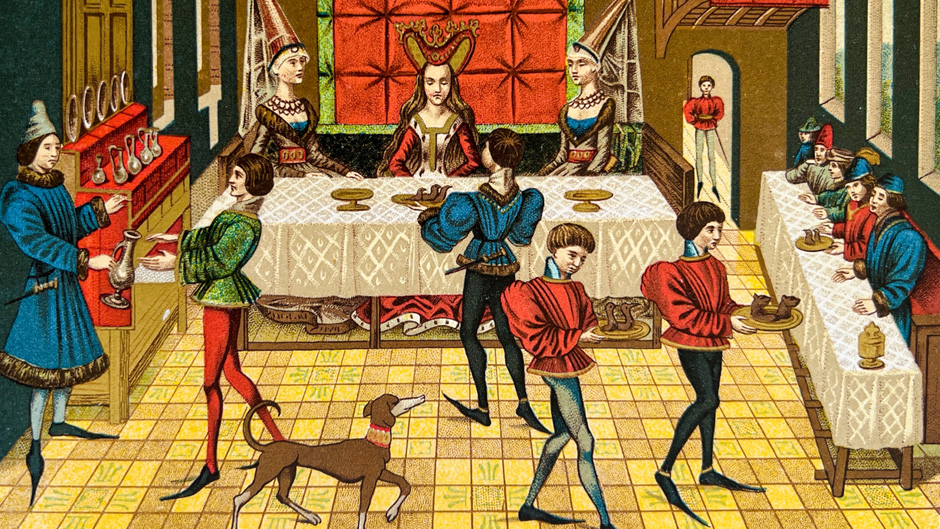
Rediscovering Health and Wellness Tips from the Middle Ages
Long before the advent of Tik-Tok and modern self-help trends, people sought guidance for health and wellness through a genre of texts known as regimen sanitatis during the late Middle Ages. These handwritten preventive medicine works offered advice that resonates even in contemporary discussions on health.
For centuries, individuals have faced challenges such as love, aging, weight concerns, and job dissatisfaction. In a quest for solutions, many have turned to various sources, or engaged in preventive practices like monitoring diet, sleep, and exercise.
The current global self-help market is valued at approximately $45 billion.
‘We know that people have always practiced preventive medicine, yet physicians or medical writers rarely wrote the advice down, so much is lost in history that we don’t know about,’ says Noa Nikolsky, a professor of English at the University of Miami College of Arts and Sciences.

Nikolsky, who specializes in medieval literature and the history of medicine, has focused on the Regimens of Health that surged following the 12th-century Renaissance. These texts significantly transformed the landscape of well-being, particularly among common people.
‘There’s an explosion of scientific writing and an influx of new knowledge. We begin to see a lot of texts about prevention, so suddenly these wellness guides become textualized,’ she explains.
Unlike prior medical texts aimed at physicians or the affluent, these regimens were accessible, written in vernacular language for ordinary individuals.
Nikolsky notes, ‘Many of these regimens include the caveat that if you follow this advice, you won’t need to see a physician,’ a curious detail in texts often authored by doctors.
‘They speak directly to the reader, empowering them with the notion that by engaging with this material, they hold the keys to their health,’ she emphasizes.
Interesting Insights into Medieval Diet
As those familiar with health will assert,
Certain food combinations, like cheese and eel, may be unwise,
Unless accompanied by wine.
Translation from Regimen Sanitatis Salernitatum, a notable medical poem from the 12th-13th century in Salerno, Italy.
‘Preventive medicine holds immense importance because curative interventions can be risky,’ Nikolsky states, stressing the need for accessible healthcare strategies long before modern pain relief measures were available.
The popularity of these regimens is tied to the rise of educational institutions and a more literate public, fostering a demand for practical wellness literature.
‘This is about providing tangible, day-to-day health rules. It isn’t limited to religious contexts; it’s fundamentally about health,’ Nikolsky remarks. ‘These guides are remarkably similar to modern self-help books.’
In the Middle Ages, universities served as knowledge centers for physicians, yet these regimens often derived from practitioners outside formal training — barber surgeons, apothecaries, and community members.
‘Knowledge was diverse and accessible. Speaking to someone with firsthand experience was often as valuable as consulting a trained physician,’ she adds.
Nikolsky’s research examines whether these texts can be classified as legitimate medical practice.
‘While not a direct consultation, reading these texts becomes a unique form of engagement with medicine,’ she highlights.
Though she refrains from evaluating the medical validity of these regimens, she acknowledges their significance in promoting body awareness and health practices.’These texts advocate for attention to diet, exercise, and sleep habits that influence well-being,’ Nikolsky notes. ‘Our understanding of psychosomatic health — the mind-body connection — is far from a modern concept.’
‘Regardless of the actual medical advice’s validity, these texts encourage readers to take charge of their health. They promote the idea that one’s health is within their control,’ Nikolsky asserts.
As she explores the origins of self-help literature in late medieval Europe, the message remains a timeless reminder of individual agency in health matters.
Comments are closed