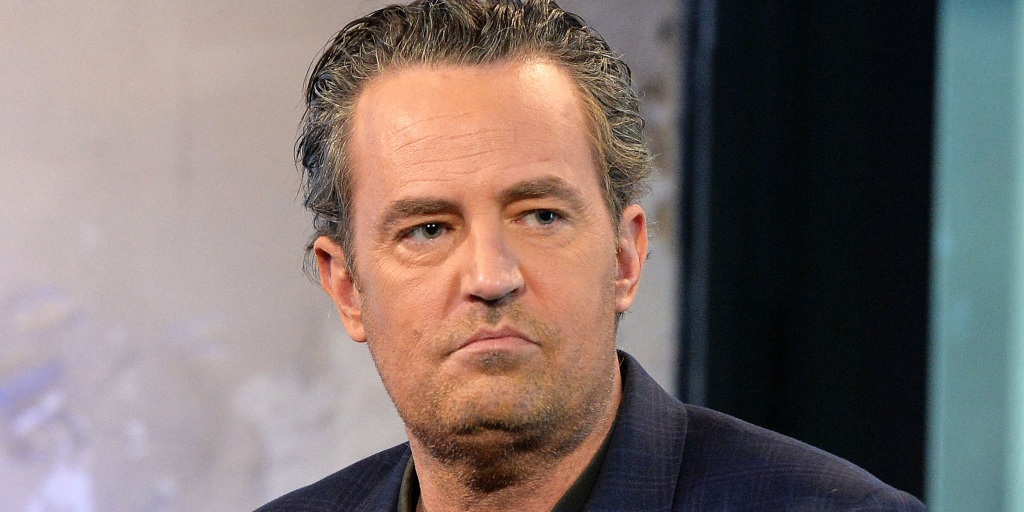
Months after Matthew Perry’s death at age 54, more details about his fatal ketamine overdose are coming to light.
The “Friends” star had been undergoing ketamine therapy prior to his death in October 2023 to treat his depression and anxiety. However, the doses administered as part of the therapy were not what killed him, according to NBC News. He had also been using the drug unsupervised and had become addicted, as stated by prosecutors.
Five individuals have been charged in connection with Perry’s death, including his personal assistant, two doctors, and a drug dealer. Ketamine is known as a popular party drug with psychedelic effects and is also used medically as an anesthetic.
Perry had been open about his health struggles over the years, particularly his battle with addiction. Here’s what we know about Perry’s health history leading up to his ketamine overdose and death.
Matthew Perry’s cause of death
Perry’s cause of death was determined to be acute effects of ketamine, according to the Los Angeles County Medical Examiner’s Office.
“Contributing factors in Mr. Perry’s death include drowning, coronary artery disease, and the effects of buprenorphine (used to treat opioid use disorder). The manner of death is accident,” the Medical Examiner’s Office stated.
The amount of ketamine found in his system was equivalent to that used for general anesthesia before surgery, according to the medical examiner’s office.
The actor was discovered at his home in Pacific Palisades after an apparent drowning on Oct. 28, 2023. Two law enforcement officers informed NBC News that there were no signs of foul play.
Matthew Perry’s health history
Perry had a long history of battling addiction, which he discussed in past interviews and in his memoir “Friends, Lovers and the Big Terrible Thing.”
He’s struggled with addiction for three decades
Perry revealed his three-decade-long struggle with addiction in an interview with People in October 2022.
His battle with alcohol addiction began during the early years of “Friends,” stating that he initially felt in control. However, by the age of 34, he found himself deeply entrenched in addiction.
Perry recalled a time when he dropped to 128 pounds and was consuming over 50 Vicodin a day. Throughout his struggle, he went to rehab more than a dozen times and underwent at least 14 surgeries.
“The doctors told my family that I had a two percent chance to live,” he shared. “That’s when I really came close to my life ending.”
He’s been in rehab more than a dozen times
Perry spent decades attempting to achieve sobriety, which proved to be financially burdensome. In his memoir, he noted that he spent over $7 million on his recovery journey, including 15 rehab visits. However, in a New York Times interview, he mentioned the figure was closer to $9 million.
“I’ve been in a mental institution, gone to therapy twice a week for thirty years, been to death’s door,” he recounted.
He also shared an experience of being in rehab while “Friends” was still airing, where he was brought to set during Chandler and Monica’s wedding scene.
“I married Monica and was driven back to the treatment center — at the height of my career, the iconic moment on the iconic show — in a pickup truck with a sober technician,” he wrote.
Perry also reflected on filming the final scene of “Friends.”
“It was January 23, 2004. The keys on the counter, a guy who looked a lot like Chandler Bing said, ‘Where?,’” he wrote. “‘Embryonic Journey’ by Jefferson Airplane played, and then Ben, our first AD, shouted for the last time, ‘That’s a wrap,’ and tears sprang from almost everyone’s eyes.”
Perry recalled Jennifer Aniston “sobbing,” and even Matt LeBlanc was in tears. However, he noted that he “felt nothing,” adding, “I couldn’t tell if that was because of the opioid buprenorphine I was taking, or if I was just generally dead inside.”
He was in a coma after his colon erupted in 2019
Perry described a near-death experience in 2019 due to his colon bursting from opioid overuse.
He underwent emergency surgery for seven hours and was given a 2 percent chance of surviving the night. He wrote, “I will have to live out the rest of my days knowing that my mother and others heard those words.”
After surgery, he fell into a two-week coma, followed by a five-month hospitalization. For nine months, he had to use a colostomy bag.
“I realized that my greatest fear had come true, which is that I did this to myself,” he expressed.
His heart stopped for 5 minutes
Perry recalled another near-death experience in his memoir, describing a time in a rehab facility in Switzerland where he was up all night taking hydrocodone before a surgery.
He received propofol, the drug that killed Michael Jackson, typically used for anesthesia.
During an appearance on “The Late Show with Stephen Colbert” in November 2022, he shared that he received CPR, and the man administering it broke eight ribs while saving his life.
Perry told Colbert that his “heart stopped for five minutes” but he “didn’t flatline.” He woke up in a different hospital 10 hours later.
This incident prevented Perry from participating in “Don’t Look Up” alongside Meryl Streep, as he stated, “I had to give up the biggest movie I’ve ever gotten. I had four scenes with Streep.”
His therapist helped him with his addiction
Reflecting on his struggles, Perry mentioned how his therapist assisted him in quitting drugs.
His therapist advised him to associate drugs with having to wear a colostomy bag “for the rest of (his) life.”
“I have not been interested in taking a drug since,” he stated, adding, “I’ve surrendered, but to the winning side, not the losing. I’m no longer mired in an impossible battle with drugs and alcohol. I no longer feel the need to automatically light up a cigarette with my morning coffee.”
He was using ketamine therapy before his death
Perry also mentioned in his memoir that he utilized ketamine therapy to “ease pain and help with depression.”
“Ketamine felt like a giant exhale,” he described. “They’d bring me into a room, sit me down, put headphones on me to listen to music, blindfold me, and put an IV in.”
“As I lay there in the pitch dark, listening to Bon Iver, I would disassociate, see things — I’d been in therapy for so long that I wasn’t even freaked out by this. Oh, there’s a horse over there? Fine — might as well be … As the music played and K ran through me, it all became about ego, and the death of ego.”
Some studies indicate that ketamine therapy can be an effective short-term treatment for depression that has otherwise been resistant to treatment.
Francesca Gariano is a New York City-based freelance journalist reporting on culture, entertainment, beauty, lifestyle, and wellness. She is a freelance contributor to TODAY.com, where she covers pop culture and breaking news.
Comments are closed