
Introduction
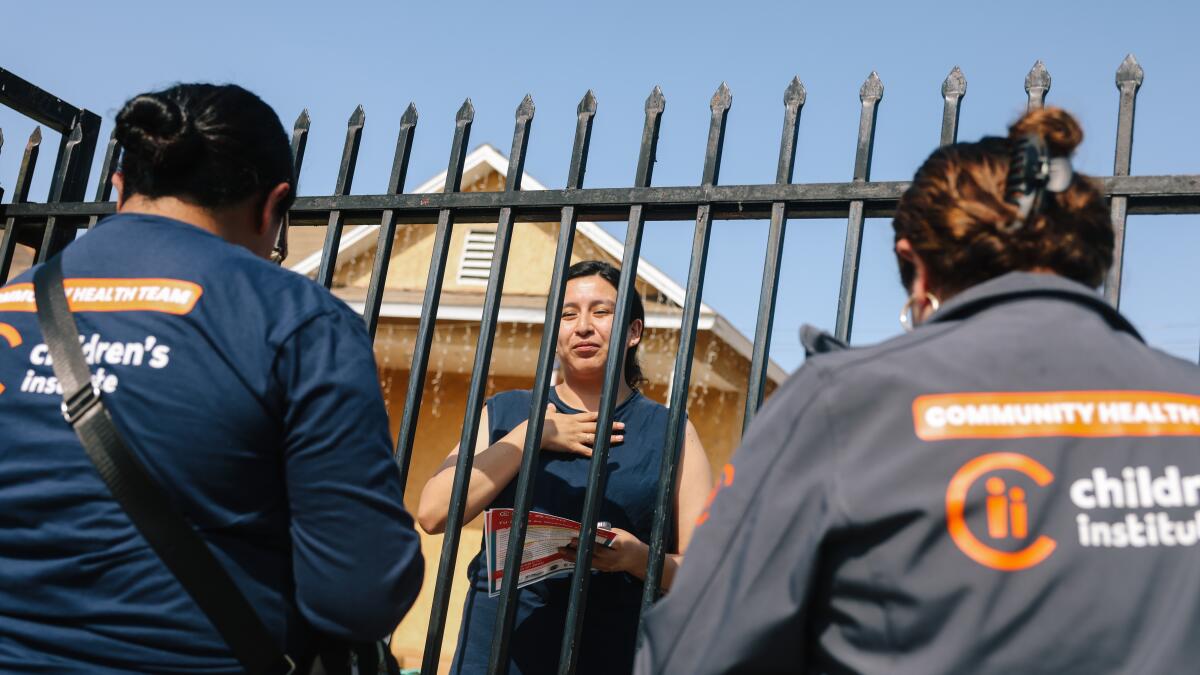
On a sweltering morning in Watts, community health worker Elizabeth Calvillo knocked on a gate, hoping to be heard over the noise of an airplane. “Good morning! ¡Buenos días!” she called out.
A young mother, still in her pajamas, emerged from the house. Calvillo and her co-worker Maria Trujillo explained their mission: to check if she or her neighbors needed anything. They asked if she was on Medi-Cal and if there was anything else she needed.
The mother, 26, expressed her frustration with the long wait times at a downtown clinic for her 3-year-old daughter’s physical. “I haven’t even gotten my checkups because it’s so hard to get an appointment,” she lamented.
Calvillo and Trujillo immediately referred her to a local clinic and promised to follow up in a week or two. The mother was relieved, “I’ve been stressing about it. You guys came at the right time!”
“That’s what we’re here for,” Calvillo replied.
Meeting People Where They Are
In Los Angeles County, the public health department is taking a proactive approach by sending teams to knock on doors in neighborhoods like Watts, Pacoima, and Lincoln Heights. The goal is to ask residents what they need and connect them with services.
“You have an actual person coming and showing that they want to be of service to you,” said Trujillo, a community health worker with Children’s Institute, one of the local groups involved in the project.
The Community Public Health Teams, run by community organizations and health groups in partnership with the county, aim to knock on 8,000 to 13,000 doors in designated areas. They conduct household assessments covering unmet medical needs, mental health, housing instability, and more, trying to connect people with services like Medi-Cal enrollment or food banks.
Personalized Healthcare
“This is bringing healthcare to the door of the individual,” said Monica Dedhia, director of community health programs for Children’s Institute, “versus waiting for someone to make an appointment.”
The pilot program is expected to last five years, with teams returning at least once a year to check on households. Tiffany Romo, director of the community engagement unit at L.A. County Public Health, likened it to “concierge service.”
Even after linking someone with healthcare or other services, the teams will follow up to ensure they received what they needed.
Learning from Other Countries
This approach is more common in countries like Costa Rica and Cuba, where health workers visit households to forge closer connections between health agencies and communities. Costa Rica, for example, saw a significant drop in potential years of life lost, especially among its poorest residents.
However, it’s “rarely done in the U.S.” for health workers to be responsible for the entire population in a geographic area, said Dr. Asaf Bitton, associate professor of medicine and healthcare policy at Harvard. “That’s a whole different orientation.”
Funding and Future Goals
The pilot program relies on $75 million from a federal grant spread over five years, providing $1.5 million to each team in 10 “high need” areas.
Success under the program is defined by the community, but public health officials hope it will reduce inequities and result in healthier neighborhoods. Analyzing the gathered information will also help inform future public health efforts.
Challenges and Trust
One major challenge will be getting people to open their doors. In Watts, for instance, the community “has been heavily surveyed, but the follow-up isn’t necessarily there all the time,” said Dedhia.
Despite these challenges, Ferrer believes the program will build trust quickly if it can deliver on its promises. “A lot of people have things that they need help with — and they’re not getting help,” she said.
“We’ll build trust very quickly,” she added, “if we can deliver on that.”
For more information, visit the Los Angeles Times.
No responses yet